
July 11, 2007

Taking an axe to the Tree of Life

Evolutionary biology has moved past Darwin's model

By Marla Cranston

Tools for this article:  Email  |  Print  |  Comment
  |  
Share on Facebook Facebook  |   Submit article to Stumble Upon StumbleUpon  |   Bookmark on del.icio.us del.icio.us  |   Digg this Digg
The Tree of Life "misleads us," says Dr. Ford Doolittle.(Abriel photo)

Most people – including scientists – can’t see the forest for the Tree, when it comes to understanding the theory of evolution.

Charles Darwin’s famed Tree of Life hypothesis limits and even obscures the study of organisms and their ancestries, according to a group of Dalhousie molecular biologists. What’s the danger in believing that all beings of the same class, living and extinct, derive from a single figurative “tree” and its branches?

“It’s not true, that would be the main danger. It misleads us,” says Ford Doolittle, Dalhousie’s Canada Research Chair in Comparative Microbial Genomics.

Not much was known about primitive life forms or genetics back in 1859, when Darwin wrote his book, On the Origin of Species by Natural Selection.

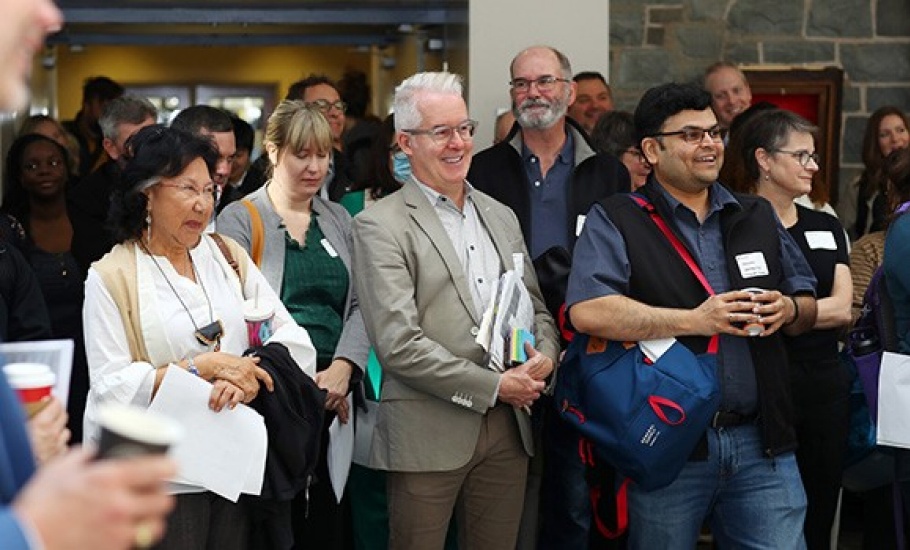
“At that time, he was dealing with plants and animals, long before there was any real comprehension of DNA or bacteria,” Dr. Doolittle told a Tree of Life symposium on campus June 27, during the international conference of the Society for Molecular Biology and Evolution (SMBE).

Charles Darwin

To question is "the heart of science"

Many scientists won’t let the Tree of Life go without a battle, judging by a heated argument at the conference last week.

Darwin’s model is no stranger to controversy. Historically, it played a key role in the much larger debate with creationists, “serving as the ladder that helped the community climb to acceptance (of the theory of evolution),” according to  groundbreaking research by Eric Bapteste.

But it’s time to update that ladder with new rungs. Dal’s molecular biologists are taking great care with this task, so evolution’s opponents don’t misinterpret their revisions as an abandonment of Darwin’s most basic premise, that we can explain the adaptability and diversity of living creatures as solely the outcome of natural processes operating over time.

There are many opponents – a new Angus Reid poll shows that 22 per cent of Canadians still believe “God created human beings in their present form within the last 10,000 years,” and 19 per cent more are on the fence. “It’s much worse in America,” where nearly half the population still embraces creationism, notes Dr. Doolittle. 

“If somebody wants to believe in miracles, that’s fine,” he says. “But not believing in miracles is the essence of being a scientist…science is not a religion. The fact that we might change our minds or our views someday, but stay within the paradigm of naturalistic explanation, gets to the very heart of science.”

Current research is finding a far more complex scenario than Darwin could have imagined, particularly in relation to bacteria, archaea and one-celled organisms. These simple life forms represent most of the earth’s biomass and diversity, not to mention the first two-thirds of the planet’s history. Many of their species swap genes back and forth, or engage in gene duplication, recombination, gene loss or gene transfers from multiple sources.

Dr. Doolittle and postdoctoral fellow Eric Bapteste highlight these varied genetic pathways and propose alternative tools and models in their paper, “Pattern pluralism and the Tree of Life hypothesis,” published in a recent PNAS journal, by the National Academy of Sciences of the United States of America. (Dr. Bapteste just picked up his second PhD, in Philosophy, from the Sorbonne.)

Understanding how cells evolve and mutate is incredibly important – it’s helping scientists learn why some diseases are resistant to vaccines and antibiotics, and why others can evade the immune system. It’s leading to environmental solutions too – some bacterial genes can break down harsh contaminants such as benzene into harmless byproducts.

Yet many scientists are reluctant to abandon Darwin’s 150-year-old hypothesis, partly because it’s always been ingrained as accepted fact, and perhaps because it meets our basic need for order and organization.

“People were born to classify things. It’s a natural and useful human practice,” says Dr. Doolittle. But such focus on building historical hierarchies based on outmoded assumptions can get in the way of real science and discovery, he stresses.

That’s not the case at Dalhousie, which has gained a reputation as one of the world’s leading centres of excellence in molecular evolutionary biology through work by Dr. Doolittle and Drs. Michael Gray, John Archibald, Andrew Roger and other researchers in the Department of Biochemistry and Molecular Biology, plus at least a dozen colleagues in Biology, Mathematics and Statistics and Computer Science. It’s still a relatively young field of study, emerging with the discovery of DNA structure in the 1950s.

The SMBE’s conference in late June drew a record 700 scholars from 25 countries, including such acclaimed evolutionists as Sir Alec Jeffreys, inventor of DNA fingerprinting and profiling techniques, and British biochemist Nick Lane, who gave a public lecture on his book, Power, Sex, Suicide: Mitochondria and the Meaning of Life. Dalhousie was chosen to host the meeting in recognition of its premier role in the field.


Readers Say

Have a comment on this story? Share your thoughts with us.

Name: (first and last required)

Town or City:

Dalhousie Faculty, School, or Department (if applicable, or other affiliation):

Email (will not be shown):

characters remaining: 2000Comment:
Editorial Policy